
DUAL MATERIALITY ANALYSIS · EU (VSME/ESRS) / UK (SRS)
Your dual materiality analysis.
On one afternoon.
We handle all the preliminary work: Based on your data, our ESG AI and experienced subject matter experts conduct a dual materiality analysis in accordance with EU requirements (ESRS/VSME) as well as a financial materiality analysis in accordance with UK SRS. In the workshop, we review and finalize the results together with you—in a structured, efficient manner, and without blank flip charts.
1/2 day
A workshop instead of a project lasting several months.
~ 15 hours
The total time required — review plus workshop.
~ 12 pages
DWA (EU) or Financial Materiality Analysis (UK).
~ 20 IROs
Relevant IROs, according to EU (VSME/ESRS), and ROs according to UK (RSR).
THE PROCESS
Three steps.
We’ll take care of most of it.
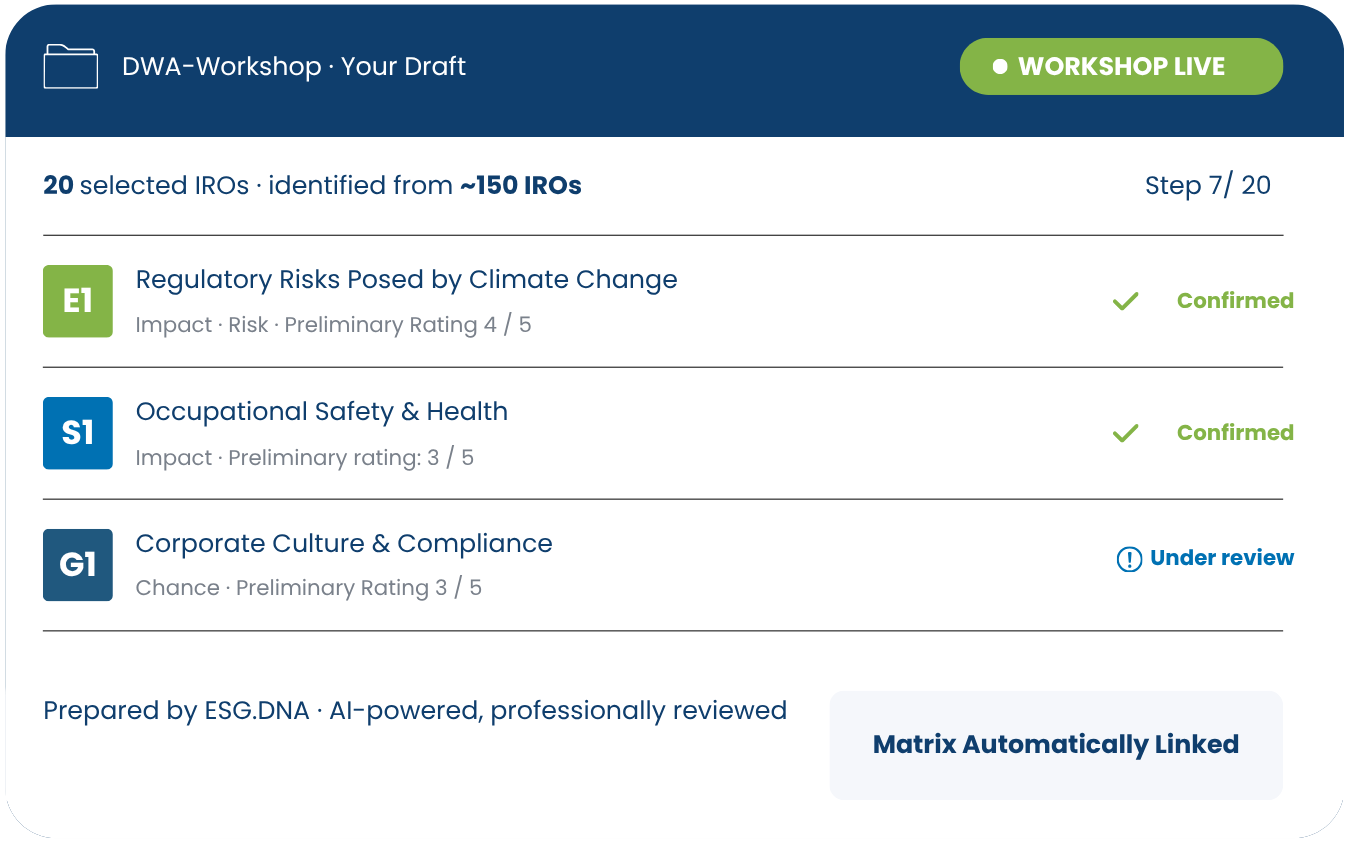
We'll prepare your analysis before the workshop begins. You'll arrive to find a finished draft—and simply approve it, rather than starting from scratch.
Collect data
You provide us with existing documents: annual reports, brochures, press releases and everything else relating to your company. We supplement these with industry reports and use them to build your database.
AI-assisted design
Our in-house ESG AI identifies around 150 IROs. Our subject matter experts select the ~20 most relevant ones, categorise them according to the ESRS, provide justifications and carry out an initial assessment.
Confirmation during the workshop
During a half-day session, we will go through the draft with your management team step by step. You will approve it, add comments and set priorities: the workshop is a confirmation, not the starting point.
SHORTLY EXPLAINED
What "double materiality" means.
The DWA examines each ESG issue from two perspectives. Only when both are considered together do they provide the full picture for your report.
INSIDE-OUT · MATERIALITY
How does your company operate?
You provide us with existing documents: annual reports, brochures, press releases and everything else relating to your company. We supplement these with industry reports and use them to build your database.
OUTSIDE-IN · FINANCIAL MATERIALITY
How does it make you feel?
The UK Sustainability Reporting Standards (UK SRS) follow the ISSB's financial materiality perspective.
THE RESULT
Results ready for reporting, to be imported.
In the end, you’ll receive everything in writing: ready for your sustainability report and providing a clear overview of your ESG position.
- Around 12 pages of the DWA draft, structured in accordance with ESRS — ready to be incorporated directly into the sustainability report.
- IROs assessed and justified, every impact, every risk and every opportunity is documented in a transparent manner.
- Strategy points, where your ESG risks lie, where you should make improvements, and where you should increase transparency.
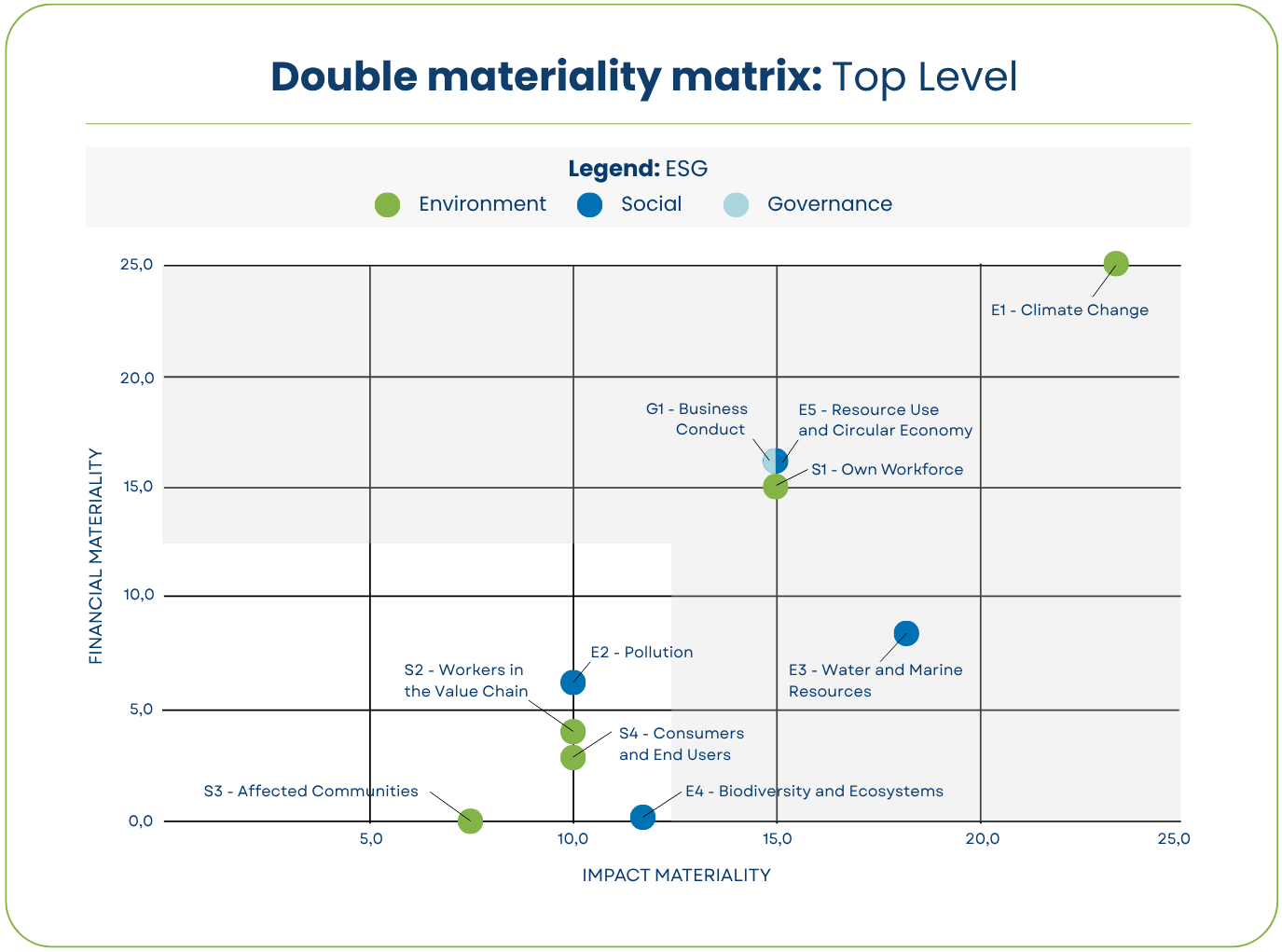
- Automatically generated materiality matrix, linked to your reviews.
- Financial materiality identify and quantify risks and opportunities.
ALLOCATION OF EXPENSES
We bear the burden of preparation.
We handle all the intensive groundwork. Your team can focus on what only you can decide: confirming and prioritizing.
TRADITIONAL APPROACH
Projects lasting several months
- Around 12 pages of the DWA draft, structured in accordance with ESRS — ready to be incorporated directly into the sustainability report.
- IROs assessed and justified, every impact, every risk and every opportunity is documented in a transparent manner.
- Strategy points, wo Ihre ESG-Risiken liegen, wo Sie optimieren und wo Sie mehr Transparenz schaffen sollten.
- Automatically generated materiality matrix, linked to your reviews.
WITH ESG.DNA
Half a day
- Final draft is available — you are confirming it rather than compiling it.
- We’ll take care of the groundwork — AI-powered and expert-reviewed.
- ~15 hours Total cost on your side, including the workshop.
- Results ready for reporting — available for collection on the same day.
BEFORE / AFTER
The difference from the traditional DWA.
It used to be a project lasting months, starting with a blank flipchart. Now it’s a prepared draft that you can approve in a single afternoon.
OUR EFFORT
~20
hours of preparation

Data preparation, IRO identification using our own ESG AI, technical selection, classification according to ESRS, justifications and preliminary assessment.
YOUR EFFORT
~15
hours in total

~10 hours Review of the draft plus ~½ day Workshop. That’s all you need to do.
Speed through technology.
Reliability through expertise.
This speed is only possible through the use of AI. The quality is ensured by experienced ESG specialists who take responsibility for every step.
In-house ESG AI
Developed specifically for ESG: It extracts IROs from your database in a structured manner and speeds up a process that would otherwise take weeks.
Proven specialist expertise
Experienced ESG advisers select the relevant IROs, classify them correctly according to the ESRS and take responsibility for each assessment. AI provides the suggestion and humans make the decision.
Transparency
We disclose where we use AI and where human review comes into play. This ensures that you can understand how your result is arrived at.
FREQUENTLY ASKED QUESTIONS
Good to know
How long does the workshop last?
The workshop itself lasts half a day (around five hours). During this time, we will go through the prepared draft together and finalise it step by step.
What information do you need from us?
The documents you already have are sufficient: annual reports, brochures, press releases, and general information about your company. We’ll supplement them with industry reports. You don’t need to create anything new.
Do you use AI?
Yes, and we are open about this. We use AI developed specifically for ESG to identify the IROs. Our subject matter experts are responsible for the selection, categorisation and assessment. It is this combination that makes this pace possible in the first place.
Is the result compliant with the CSRD and ESRS?
Yes. The IROs are systematically categorised, assessed, justified and structured in accordance with the ESRS categories (E1–E5, S1–S4, G1) for inclusion in your sustainability report.
What do we end up with?
A DWA draft of around twelve pages, ready for reporting; an automatically generated materiality matrix; and specific strategic points: where your ESG risks lie, where you should optimise, and where you should create greater transparency.
Who should take part in the workshop?
Ideally, the management team and those responsible for ESG, finance and health and safety: in other words, the people who can endorse and prioritise these issues.